
#ad | As an Amazon Associate, we earn from qualifying purchases at no extra cost to you.
Disclosure: As an Amazon Associate, I earn from qualifying purchases.
For home cooks using gas or electric hobs, the Tefal Kadai Curry Pan 26cm addresses a specific gap in cookware: the need for a deep, curved vessel that handles authentic Indian techniques without requiring heavy oil or specialized steel maintenance. Its 26cm diameter provides sufficient surface area for family-sized portions of lentils and curries, while the aluminium base ensures rapid heat distribution across the curved bottom. However, the most critical specification to note is that this model is explicitly not compatible with induction hobs, a limitation that immediately disqualifies a significant portion of modern UK kitchens. This review analyzes the practical implications of its non-stick coating, size, and material composition for home cooks.
🛒 Check Price on Amazon →✓ See today's price & reviews
Summary: This pan solves the problem of preparing authentic Indian curries at home with minimal sticking and easy cleanup. Its standout feature is the Thermo-Spot indicator, which visually confirms when the pan has reached the optimal cooking temperature, reducing guesswork. The primary limitation is its incompatibility with induction cooktops, restricting its use to gas, electric, and ceramic hobs only. It is best for home cooks with gas or electric hobs who want to prepare authentic Indian dishes with less oil and easier maintenance than traditional steel.
Cooking Large Batches of Dal on a Gas Hob Without Sticking
The 26cm diameter of this kadai is sized to accommodate family-sized portions, allowing you to prepare meals for four or more people in a single vessel. Unlike shallow frying pans that require multiple batches for larger groups, the depth and width of this specific model allow for the simmering of lentils and the reduction of curries without overcrowding the ingredients. This capacity is particularly useful for dishes like dal makhani or chana masala, where the ingredients need space to move and absorb flavors as they cook down.
The aluminium construction plays a crucial role in how heat is distributed across the curved bottom of the pan. Aluminium is a highly conductive metal, meaning it heats up quickly and spreads heat evenly, which is essential for the curved shape of a kadai. This prevents hot spots that can cause food to burn in one area while remaining raw in another, a common issue with heavier cast iron or stainless steel alternatives that heat more slowly. For delicate ingredients like paneer or fish curries, this even heat distribution helps maintain texture and prevents the food from breaking apart or sticking to the bottom.
The non-stick coating is critical for low-oil cooking, which is a key advantage for health-conscious cooks. Traditional steel kadais often require a generous amount of oil or ghee to prevent food from sticking, especially when tempering spices or frying onions. With this Tefal model, the durable non-stick surface allows you to use significantly less fat while still achieving a non-stick result. This is particularly beneficial for beginners who may struggle with the technique required to cook in uncoated metal, as the coating provides a forgiving surface that reduces the likelihood of food adhering to the pan.
The Role of Aluminium in Heat Distribution
The choice of aluminium as the primary material is a deliberate design decision that prioritizes responsiveness over heat retention. While cast iron retains heat well, it is slow to react to changes in temperature, which can lead to overcooking if the heat is not managed carefully. Aluminium, by contrast, reacts quickly to changes in heat input, allowing for precise control during the cooking process. This is particularly useful when moving from the initial high-heat tempering of spices to the lower-heat simmering of the curry base. The rapid response time ensures that you can adjust the heat on your gas or electric hob without waiting for the pan to cool down or heat up significantly.
Managing Delicate Ingredients
Cooking delicate ingredients like fish or paneer in a kadai can be challenging due to their tendency to break apart or stick to the bottom of the pan. The non-stick coating on this model provides a surface that allows these ingredients to be moved around easily without the risk of tearing. This is a significant advantage over traditional steel, where the lack of a non-stick surface often requires careful handling and a higher amount of oil to prevent sticking. For home cooks who want to prepare lighter, healthier versions of traditional dishes, this feature makes the process much more manageable and less stressful.
If You Have an Induction Hob, This Pan Will Not Work
The most important specification to consider before purchasing this pan is its compatibility with your hob type. The product description explicitly states that this pan is NOT compatible with induction hobs. This is a direct result of its aluminium construction, as induction hobs require a magnetic base to generate heat. Aluminium is not magnetic, meaning it will not work on an induction cooktop. If your kitchen is equipped with an induction hob, this pan will not function, and you will need to look for a different model with a magnetic base or a different material entirely.
This limitation is a significant consideration for UK households, as induction hobs are becoming increasingly common in new builds and kitchen renovations. If you have a mixed hob setup, such as a combination of gas and induction, you will need to ensure that you have a separate pan for your induction hob. This can be inconvenient if you rely on a single kadai for all your Indian cooking, as you will need to switch between different pans depending on which hob you are using. It is essential to check your kitchen setup before purchasing to avoid the disappointment of buying a pan that does not work with your existing equipment.
For those with gas, electric, or ceramic hobs, this pan is fully compatible and will perform as expected. The aluminium base is designed to work efficiently with these heat sources, providing even heating and responsive temperature control. If you are unsure about your hob type, you can check the manufacturer’s specifications or look for a symbol on the base of your existing cookware. Many modern hobs are multi-fuel, meaning they can accommodate different types of cookware, but induction-specific hobs will not work with non-magnetic materials like aluminium.
Checking Your Hob Compatibility
Before purchasing, it is crucial to verify the type of hob you have in your kitchen. Induction hobs are easily identifiable by their smooth glass-ceramic surface and the fact that they only work with magnetic cookware. If you have an induction hob, you will need to look for a kadai with a magnetic base, such as one made of stainless steel or cast iron. Alternatively, you can use an induction adapter, but this is not recommended for regular use as it can be inefficient and may not provide even heating. For gas and electric hobs, this aluminium kadai is a suitable choice and will provide excellent performance.
The Impact on Kitchen Workflow
Having a pan that does not work with your primary hob type can disrupt your kitchen workflow, especially if you rely on a single kadai for all your Indian cooking. If you have an induction hob and a gas hob, you may find yourself needing to switch between two different pans, which can be time-consuming and inconvenient. This is a practical consideration that should not be overlooked, as it can affect the overall efficiency of your cooking process. If you have a mixed hob setup, it may be worth investing in a second kadai that is compatible with your induction hob to ensure you have the right tool for the job.
Choosing Between the 24cm and 26cm Sizes for Your Household
The Tefal Madras Collection offers this kadai in two sizes: 24cm and 26cm. Choosing the right size depends on your typical serving sizes and the types of dishes you plan to cook. The 26cm model is better suited for larger households or those who frequently cook for four or more people, as it provides more surface area and depth for larger batches. The 24cm model, on the other hand, is more appropriate for smaller households or those who cook for two to three people, as it is easier to handle and requires less oil and ingredients.
The depth of the kadai also plays a role in splatter control, which is particularly important when frying onions or tempering spices. The curved sides of the kadai help contain the ingredients and reduce splatter, but the size of the pan affects how much space there is for the ingredients to move. A larger pan like the 26cm model provides more room for the ingredients to spread out, which can help reduce splatter and make the cooking process safer. However, a smaller pan like the 24cm model may be easier to manage if you are cooking smaller portions, as it is less likely to overflow or spill.
When deciding between the two sizes, consider the types of dishes you plan to cook most often. If you frequently prepare large batches of dal, curry, or biryani, the 26cm model is likely the better choice. If you mostly cook smaller portions or prefer to cook in smaller batches, the 24cm model may be more suitable. It is also worth considering the size of your hob, as a larger pan may not fit comfortably on a smaller burner. Ensure that the pan fits well on your hob to ensure even heating and safe cooking.
Serving Size Considerations
The 26cm diameter of this kadai is designed to accommodate family-sized portions, making it ideal for households with four or more members. This size allows you to prepare a full meal in a single vessel, reducing the need for multiple pans and simplifying the cooking process. For smaller households, the 24cm model may be more appropriate, as it provides enough space for two to three servings without being overly large. The choice between the two sizes ultimately depends on your specific needs and the types of dishes you plan to cook.
Splatter Control and Safety
The curved design of the kadai helps contain ingredients and reduce splatter, which is a significant safety advantage over flat-bottomed pans. When frying onions or tempering spices, the high heat can cause oil to splatter, which can be dangerous if it comes into contact with your skin or clothing. The depth and curvature of the kadai help contain the ingredients and reduce the risk of splatter, making the cooking process safer and more manageable. This is particularly important for beginners who may not have the technique to control splatter in a flat pan.
Maintaining the Non-Stick Coating on Non-Induction Hobs
The non-stick coating on this kadai is designed to be durable, but proper care is essential to maintain its performance over time. The product description states that the coating has been tested through 8,000 abrasion cycles, which ensures optimum glide over time. However, this does not mean the coating is indestructible, and it can be damaged by improper use or cleaning. To preserve the coating, it is essential to use gentle cleaning methods and avoid abrasive materials that can scratch the surface.
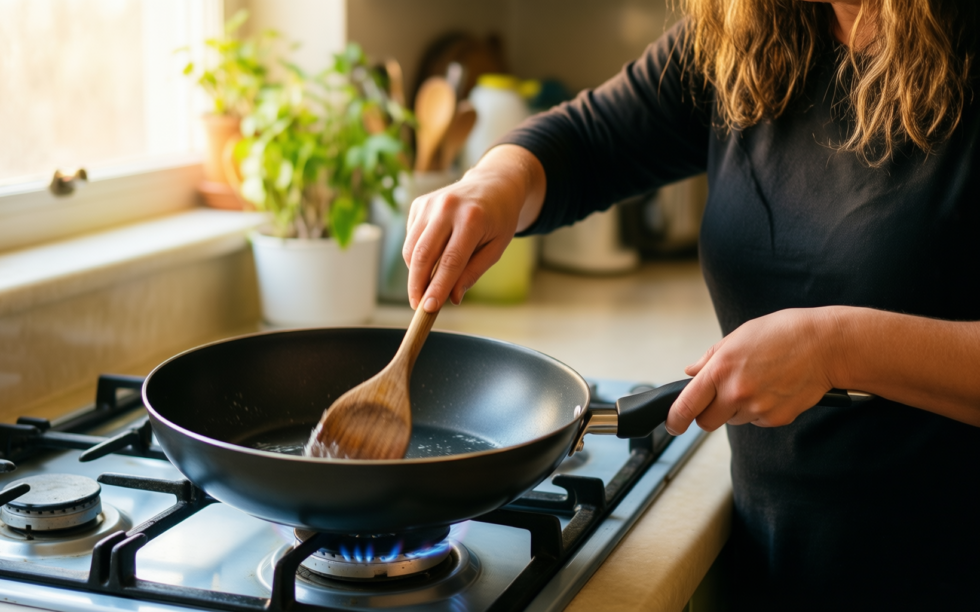
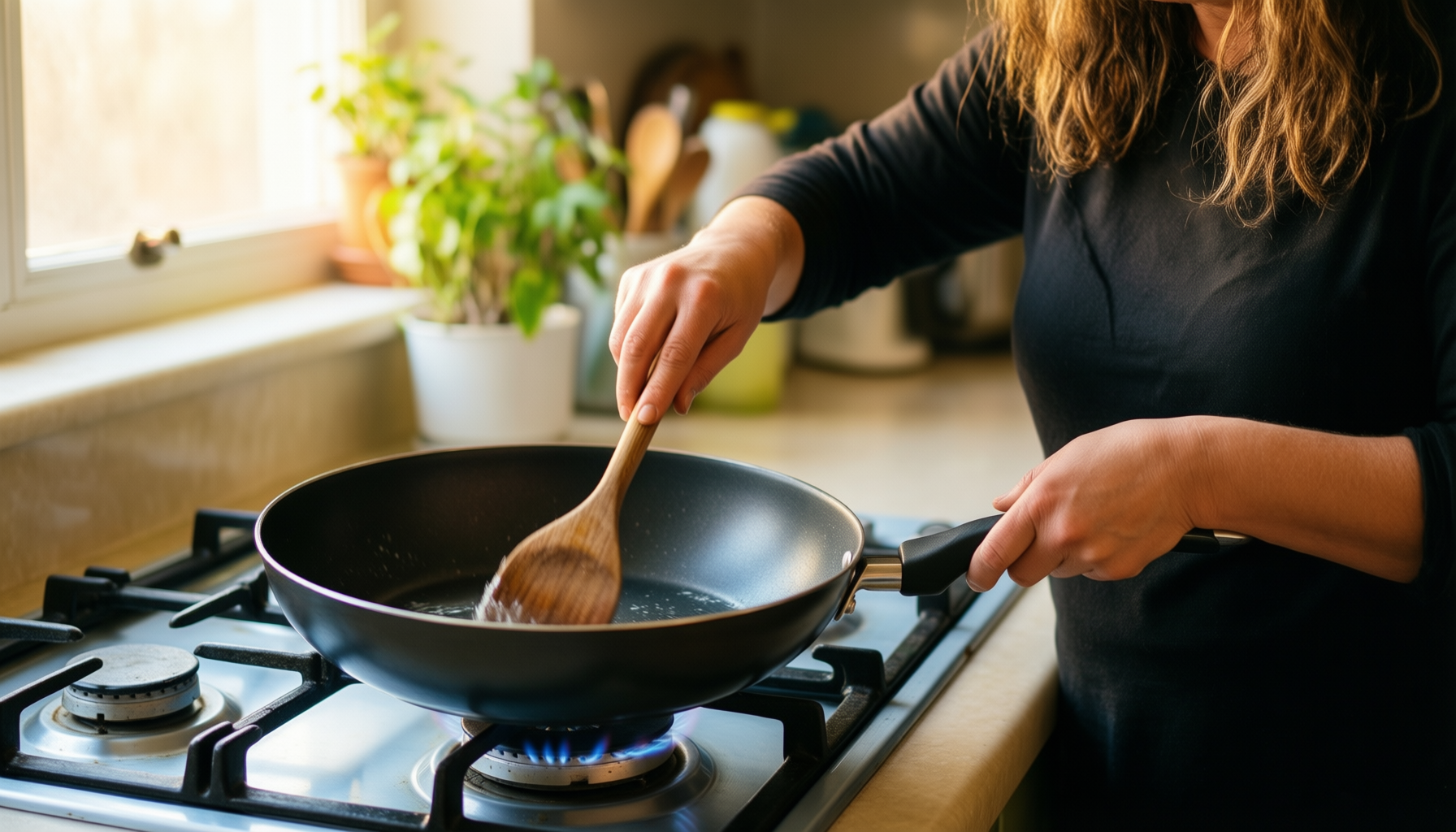
Using wooden or silicone utensils is essential to prevent scratching the non-stick coating. Metal utensils can easily scratch the surface, which can compromise the non-stick performance and lead to food sticking. Wooden or silicone utensils are softer and less likely to damage the coating, making them the preferred choice for cooking with this pan. It is also important to avoid using sharp tools or knives directly on the surface of the pan, as this can also cause scratches and damage the coating.
Cleaning the pan after use is another important aspect of maintaining the non-stick coating. It is recommended to wash the pan by hand with warm water and a mild detergent, using a soft sponge or cloth. Avoid using abrasive sponges or scrubbers, as these can scratch the coating and reduce its effectiveness. It is also important to dry the pan thoroughly after washing to prevent water spots and potential rusting, although the aluminium material is generally resistant to rust.
Cleaning and Care Tips
To maintain the non-stick coating, it is essential to follow a consistent cleaning routine. After each use, wash the pan by hand with warm water and a mild detergent, using a soft sponge or cloth. Avoid using abrasive materials or harsh chemicals, as these can damage the coating. It is also important to dry the pan thoroughly after washing to prevent water spots and potential rusting. Regular maintenance will help ensure that the coating remains effective and that the pan continues to perform well over time.
Preventing Coating Degradation
Over time, the non-stick coating can degrade if not properly maintained. To prevent this, avoid using high heat for extended periods, as this can cause the coating to break down. It is also important to avoid using the pan for deep frying or other high-heat cooking methods, as this can damage the coating. By using the pan for its intended purpose and following proper care instructions, you can extend the life of the coating and ensure that it continues to perform well.
Who Should Skip This
This pan is not suitable for households with induction hobs, as the aluminium construction is not compatible with this type of cooktop. If your kitchen is equipped with an induction hob, you will need to look for a different model with a magnetic base or a different material entirely. This is a significant limitation that should be considered before purchasing, as it will prevent you from using the pan on your primary hob.
Home cooks who prefer traditional steel kadais for high-heat searing or traditional biryani making may also find this pan less suitable. The non-stick coating is designed for low-to-medium heat cooking and is not ideal for the high-heat techniques required for searing or making traditional biryani. If you are looking for a pan that can handle high-heat cooking, a steel or cast iron kadai may be a better choice, as these materials can withstand higher temperatures and provide the desired searing effect.
Finally, those who prefer to cook in large batches for more than six people may find the 26cm size too small. While the 26cm model is suitable for family-sized portions, it may not be large enough for very large groups or commercial use. If you regularly cook for large groups, you may need to look for a larger kadai or consider using multiple pans to accommodate the volume of food.
Induction Hob Users
If you have an induction hob, this pan will not work, and you will need to look for a different model. The aluminium construction is not magnetic, meaning it cannot generate heat on an induction cooktop. This is a critical limitation that should be considered before purchasing, as it will prevent you from using the pan on your primary hob. If you have a mixed hob setup, you may need to invest in a second pan that is compatible with your induction hob.
High-Heat Cooking Enthusiasts
Home cooks who prefer high-heat searing or traditional biryani making may find the non-stick coating less suitable for these techniques. The coating is designed for low-to-medium heat cooking and may not withstand the high temperatures required for searing or making traditional biryani. If you are looking for a pan that can handle high-heat cooking, a steel or cast iron kadai may be a better choice, as these materials can withstand higher temperatures and provide the desired searing effect.
How It Compares in Its Category
Unlike traditional steel kadais, which require a generous amount of oil to prevent sticking, this Tefal model offers a non-stick surface that allows for low-oil cooking. This is a significant advantage for health-conscious cooks who want to reduce their oil intake while still preparing authentic Indian dishes. The non-stick coating also makes the pan easier to clean, as food is less likely to stick to the surface, reducing the time and effort required for cleanup.
Compared to other non-stick kadais in the market, this model stands out for its Thermo-Spot technology, which provides a visual indicator of when the pan has reached the optimal cooking temperature. This feature helps reduce guesswork and ensures that you are cooking at the right temperature, which is essential for achieving the best results. The Thermo-Spot indicator is a unique feature that is not commonly found in other non-stick kadais, making this model a more user-friendly option for beginners and experienced cooks alike.
The 26cm size of this kadai is also a significant advantage, as it provides enough space for family-sized portions without being overly large. This size is ideal for households with four or more members, as it allows you to prepare a full meal in a single vessel. Compared to smaller kadais, the 26cm model offers more versatility and can accommodate a wider range of dishes, from curries to biryani to dal.
The Thermo-Spot Advantage
The Thermo-Spot technology is a key differentiator for this model, as it provides a visual indicator of when the pan has reached the optimal cooking temperature. This feature helps reduce guesswork and ensures that you are cooking at the right temperature, which is essential for achieving the best results. The Thermo-Spot indicator is a unique feature that is not commonly found in other non-stick kadais, making this model a more user-friendly option for beginners and experienced cooks alike.
Size and Versatility
The 26cm size of this kadai is a significant advantage, as it provides enough space for family-sized portions without being overly large. This size is ideal for households with four or more members, as it allows you to prepare a full meal in a single vessel. Compared to smaller kadais, the 26cm model offers more versatility and can accommodate a wider range of dishes, from curries to biryani to dal. The depth of the pan also helps contain ingredients and reduce splatter, making the cooking process safer and more manageable.
Final Verdict
The Tefal Kadai Curry Pan 26cm is a well-designed option for home cooks with gas or electric hobs who want to prepare authentic Indian dishes with minimal oil and easier maintenance. Its 26cm diameter provides sufficient space for family-sized portions, while the non-stick coating and Thermo-Spot technology make the cooking process more manageable and user-friendly. However, the lack of induction compatibility is a significant limitation that disqualifies it for households with induction hobs. For those with compatible hobs, this pan offers a practical and effective solution for preparing authentic Indian cuisine at home.
🛒 Check Price on Amazon →✓ See today's price & reviews